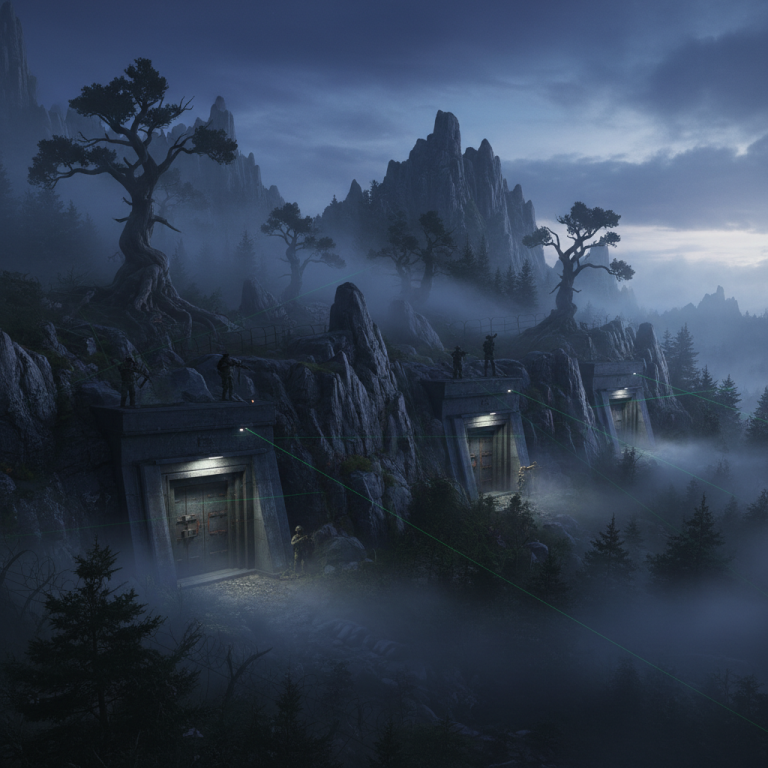

In the fourth installment of his ongoing video investigation, researcher and author Michael Salla delves into the persistent enigmas surrounding covert infrastructure, posing a fundamental geopolitical question: who ultimately controls the hidden networks beneath the surface of the modern security state? Titled Green Mountain Mystery Series Part 4: Who Controls the Hidden World?, the presentation examines long-standing claims regarding deeply buried installations, compartmentalized defense programs, and non-traditional governing bodies that operate outside standard civilian oversight.
The discussion arrives at a moment of heightened public and congressional scrutiny regarding classified aerospace activity, legacy special access programs, and federal continuity-of-government architecture. As whistleblowers and defense analysts continue to debate the transparency of black-budget military initiatives, Salla’s series highlights alternative perspectives that fuse historical continuity projects with speculative claims of advanced, covert international syndicates.
The Core Proposition: Beyond Civilian Oversight
Throughout the broadcast, Salla explores the concept of a multi-tiered hierarchy governing subterranean and black-budget installations. According to his analysis, the administrative machinery directing these secure facilities rarely aligns with visible political structures. Instead, the video posits that power is heavily concentrated within autonomous defense contractors, specialized intelligence units, and private institutional consortia that have operated uninterrupted across multiple presidential administrations.
Salla argues that early Cold War defense initiatives set in motion an unprecedented expansion of compartmentalized authority. By shielding high-priority scientific research, continuity facilities, and specialized logistics beneath layered national security waivers, the architects of these programs effectively created an insulated realm. Over decades, this institutional insulation allegedly fostered an independent cadre of decision-makers whose allegiances transcend national borders.
“The true locus of control over deeply compartmentalized assets does not rest with transient political leadership, but within entrenched private aerospace networks and institutional syndicates built to outlast conventional governments.”
Historical Context of Subterranean Defense Infrastructure
To contextualize the claims raised in the Green Mountain investigation, it is necessary to examine the documented history of underground defense construction. Following the advent of the nuclear era in the late 1940s, the United States military embarked on widespread subterranean civil engineering projects designed to safeguard command, control, and communications infrastructure.
Documented facilities such as the Cheyenne Mountain Complex in Colorado, the Raven Rock Mountain Complex in Pennsylvania, and the Mount Weather Emergency Operations Center in Virginia demonstrated that subterranean hardening was standard military doctrine. These vast, hollowed-out granite environments featured independent power generation, atmospheric filtration, and blast-resistant engineering, designed to preserve command capabilities during existential conflicts.
While public records detail the strategic logic behind these verified installations, alternative researchers such as Salla contend that the official continuity grid represents merely the public-facing facade of a substantially larger, more intricate subterranean world. In his assessment, locations associated with regional monikers like “Green Mountain” symbolize broader networks of undisclosed or privatized installations dedicated to advanced technological preservation and experimental science.
The Role of Defense Contractors and Corporate Autonomy
A central pillar of Salla’s critique centers on the privatization of advanced research and development. The video suggests that public oversight bodies, including congressional committees, face structural barriers when attempting to audit defense programs housed within private corporate entities.
By utilizing proprietary research frameworks, patent shields, and unacknowledged Special Access Programs (USAPs), major aerospace and defense conglomerates can legally restrict access to sensitive initiatives. According to Salla, this operational reality creates a shift in governance: corporate boards, executive steering committees, and corporate-military hybrids gain de facto stewardship over discoveries that remain entirely shielded from academic institutions and legislative leaders.
This dynamic, often described in fringe geopolitical literature as the “breakaway infrastructure” hypothesis, suggests that advanced breakthroughs in energy, propulsion, and materials science are managed not for broad societal deployment, but to ensure tactical and strategic dominance for a tightly held corporate network.
Compartmentalization and the Challenge of Verification
Investigating claims of this magnitude presents fundamental evidentiary challenges. By design, black-budget programs employ strict compartmentalization protocols, often termed “stovepiping.” Under these security rubrics, personnel assigned to specific operational nodes are provided only the information necessary to complete their narrow technical assignments.
Consequently, definitive proof of overarching command structures remains elusive. Critics within mainstream intelligence and academic communities argue that narratives asserting the existence of a monolithic, hidden governing body often mistake standard bureaucratic fragmentation and bureaucratic infighting for deliberate grand conspiracy. Without unredacted documentation, public satellite confirmation, or verifiable fiscal paper trails, such theories rely heavily on oral histories, whistleblower testimonies, and circumstantial anomalies.
Nonetheless, Salla maintains that the cumulative weight of historical anomalies, unexplained budget deviations, and witness statements across decades indicates a coherent, coordinated effort to maintain technological and strategic segregation.
Key Takeaways from Part 4 of the Investigation
- Autonomous Governance: The broadcast asserts that true authority over covert networks lies outside conventional executive branches, managed instead by multi-generational defense councils and corporate directors.
- Subterranean Expansion: The Green Mountain focus serves as a lens to examine claims of extensive subterranean engineering far exceeding officially declassified facilities.
- Privatized Secrecy: Special Access Programs embedded within private industry are identified as the primary barrier preventing meaningful legislative transparency.
- Continuity Architecture: The infrastructure originally designed for Cold War survival is viewed as having evolved into an autonomous logistical backbone for black projects.
Cultural and Geopolitical Impact of Alternative Governance Theories
The popularity of investigations like Salla’s reflects a broader cultural phenomenon: declining institutional trust and a growing appetite for alternative explanations of state secrecy. In an era marked by historic defense budget allocations and ongoing debates over unresolved aerial phenomena, substantial segments of the public view official denials with skepticism.
These theories intersect directly with contemporary policy debates regarding government transparency. Even within mainstream governance, lawmakers have frequently expressed frustration over their inability to track funding through complex military audits. While official investigations stop far short of endorsing Salla’s expansive hypotheses, the structural vulnerabilities they identify in oversight mechanisms provide fertile ground for speculative analysis.
What to Watch Next
As the Green Mountain Mystery series progresses, viewers should look for whether future segments introduce tangible documentary evidence, declassified records, or corroborated witness testimony to substantiate claims regarding specific corporate entities and command authorities. Critical observers will be watching closely to see if ongoing congressional efforts to reform Special Access Program classifications shed light on the operational boundaries between civilian oversight and the deeply compartmentalized defense apparatus.