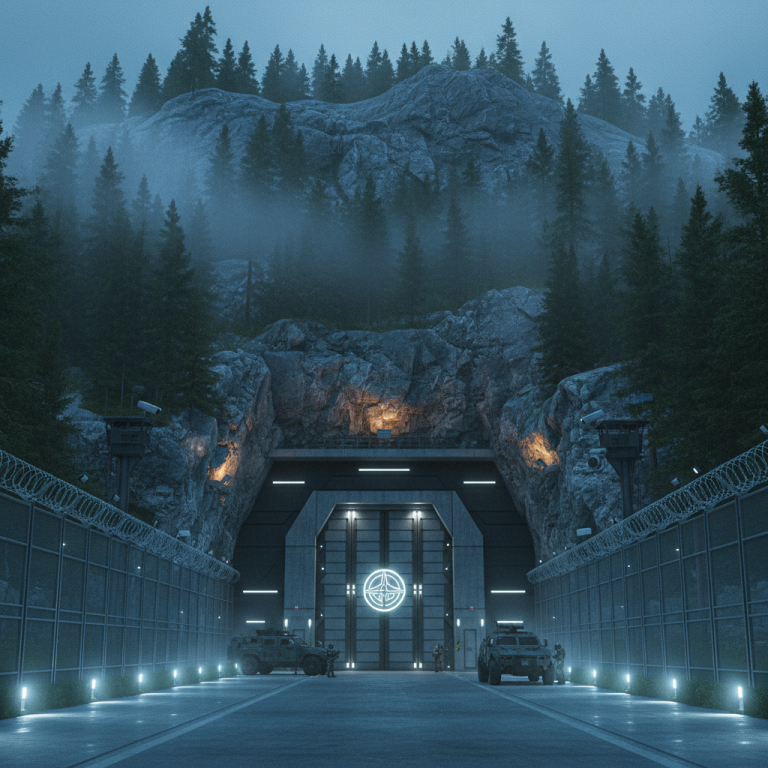

Prominent exopolitical researcher and author Dr. Michael Salla has scheduled a major broadcast event centered on what he terms the “Green Mountain” installation, drawing renewed scrutiny to the nexus between covert subterranean facilities, continuity of government architecture, and unconventional defense research. The announcement, released across his research channels, signals an expansion of Salla’s ongoing inquiries into compartmentalized black-budget programs that operate outside standard legislative oversight.
As bipartisan pressure mounts on Capitol Hill for expanded transparency regarding unidentified anomalous phenomena (UAP) and aerospace research programs, Salla’s focus on specialized geographical sites underscores how alternative research networks are mapping subterranean infrastructure against historical military programs and alleged advanced aerospace operations.
The Core Thesis Behind the Green Mountain Investigation
In his advance briefing, Salla points to “Green Mountain” as a pivotal junction within the broader framework of deep underground military installations, often referred to within aerospace and intelligence research circles as DUMBs. Salla frames the facility not merely as a Cold War-era continuity of government shelter, but as an active node participating in classified research, hardware storage, and off-grid technological development.
According to Salla’s past research and latest release, covert infrastructure projects established under high-level national security exemptions during the twentieth century have steadily evolved into complex technological ecosystems. The Green Mountain preview suggests that this specific location holds historical significance, potentially serving as a tactical nexus linking administrative continuity programs with exotic propulsion and defense hardware testing.
“The examination of sites like Green Mountain reveals a dual reality: the publicly acknowledged strategic shelters built for leadership continuity, and the deeper, compartmentalized layers where unconventional programs remain shielded from view.”
By connecting the upcoming feature to his broader exopolitical framework, Salla positions the site as part of an interconnected grid of fortified installations designed to survive surface catastrophes while harboring sensitive materials, experimental technologies, and autonomous communication networks.
Understanding the Exopolitics Paradigm
To contextualize Salla’s coverage, one must understand the foundation of exopolitics, an analytical framework he pioneered in the early 2000s. Exopolitics examines the political, institutional, and strategic dimensions of extraterrestrial intelligence, clandestine aerospace developments, and government secrecy. Rather than treating anomalies purely as astronomical or psychological phenomena, Salla treats the subject as an geopolitical reality managed through ultra-classified channels.
Over two decades, Salla has authored numerous books and white papers documenting alleged secret space programs, historical treaties between defense factions, and the corporate-military syndicates that run compartmentalized aerospace initiatives. In this analytical system, deep underground installations serve as the physical backbone enabling operations to remain hidden from satellite surveillance, public scrutiny, and congressional audit cycles.
While mainstream academics and traditional defense analysts frequently view exopolitical hypotheses with intense skepticism, the movement has cultivated a significant international audience. Crucially, several baseline premises that Salla has long argued—specifically that non-acknowledged special access programs manage anomalous aerospace technologies—have found unexpected resonance in recent congressional hearings and whistleblower testimonies presented before the U.S. House of Representatives.
Subterranean Infrastructure and Continuity of Government
Underground defense facilities are an established component of modern military posture. Originating during the height of the nuclear standoff between the United States and the Soviet Union, installations like Cheyenne Mountain in Colorado and the Raven Rock Mountain Complex on the Pennsylvania-Maryland border were engineered to maintain command, control, and communications under severe existential threats.
Investigative journalists and defense historians have thoroughly documented how these hardened structures expanded far beyond simple bomb shelters. Facilities constructed within bedrock require sophisticated atmospheric filtration, geothermal or nuclear auxiliary power, dedicated rail lines, and shielded data corridors. In his ongoing analyses, Salla argues that this acknowledged infrastructure merely represents the baseline upon which an unacknowledged tier of research installations was built.
The reference to “Green Mountain” resonates with historical continuity programs across North America and Europe, where regional command hubs and emergency operations complexes were carved into stable geological formations. Salla suggests that understanding these facilities requires interrogating how classified defense budgets—often obscured within obscure budget lines—fund multi-decade subterranean engineering projects without conventional oversight.
Key Takeaways from the Green Mountain Announcement
- Targeted Geographical Inquiry: The investigation focuses on the strategic role of the Green Mountain complex within regional and national defense architecture.
- Integration with Classified Programs: Salla links standard continuity of government hardening to covert research and development involving advanced technological hardware.
- Continuity with Whistleblower Testimonies: The report draws upon narratives gathered from former military personnel, aerospace contractors, and intelligence insiders who describe compartmentalized underground networks.
- Broadening Legislative Parallels: The release aligns with ongoing Capitol Hill inquiries into unacknowledged Special Access Programs (USAPs) and aerospace secrecy.
- Exopolitical Contextualization: The presentation frames subterranean bases as essential physical infrastructure for long-range covert space and defense programs.
The Intersection with Modern Congressional UAP Inquiries
The timing of Salla’s investigation coincides with historic developments in Washington regarding government transparency. Following the high-profile 2023 congressional testimony of former intelligence official David Grusch, claims that the United States possesses covert recovery and reverse-engineering programs transitioned from internet forums to official congressional transcripts.
Grusch testified under oath before the House Oversight Committee that retrieval materials and non-human biological artifacts have been housed within compartmentalized programs managed across defense contractors and subterranean test ranges. While Grusch did not publicly detail specific named sites like Green Mountain in open session, his legal disclosures to the Intelligence Community Inspector General catalyzed renewed interest in where physical assets might be sequestered.
Salla argues that independent researchers must bridge the gap left by official redactions. Where mainstream media outlets focus primarily on policy maneuvers and aerial encounters recorded by Navy aviators, Salla’s reporting directs attention downward, emphasizing the physical facilities, contractor facilities, and underground complexes that would theoretically manage long-term recovery and analysis operations.
Historical Precedents: The Secrecy of Subterranean Engineering
The physical feasibility of massive subterranean facilities has long been established by historical precedents. Projects like the Manhattan Project’s buried test complexes, Project Iceworm in Greenland, and the subterranean corridors beneath Mount Weather demonstrate that substantial military engineering can remain operational for decades under deep security classifications.
Salla’s research frequently cites declassified Cold War documentation showing that the U.S. military investigated atomic boring machines, specialized tunnel-boring technologies, and deep cavity excavation techniques throughout the late twentieth century. In his published work, Salla posits that these engineering methodologies were rapidly expanded to create high-speed transit networks connecting remote defense test sites across the American West and eastern seaboard.
While critics argue that the logistics, thermal signatures, and waste-rock displacement of such vast subterranean networks would inevitably betray their existence, Salla maintains that compartmentalization, selective contracting, and geographic camouflage have effectively concealed these assets from routine public observation.
Critical Reactions and Methodological Challenges
Analytical coverage of Salla’s work requires acknowledging the sharp divide between mainstream journalistic verification and exopolitical research methodologies. Traditional defense journalism relies on verified declassified records, on-the-record official statements, and corroborating technical blueprints. In contrast, researchers like Salla routinely integrate insider testimonies, whistleblower interviews, and intuitive geopolitical analysis.
Skeptics note that whistleblower accounts in the realm of black programs can sometimes be vulnerable to disinformation, personal embellishment, or counterintelligence interference. Critics caution against accepting claims regarding deep underground facilities without independent physical corroboration, soil sampling, or verifiable budgetary trails that specifically link particular mountain ranges to exotic technology retrieval.
Conversely, proponents of Salla’s framework argue that strict traditional verification standards are virtually impossible to meet when analyzing programs designed from inception to deceive standard investigative techniques. In their view, persistent testimonies matching across decades and distinct witness cohorts provide sufficient qualitative justification to treat these locations as active research subjects.
What to Watch Next
Following the Friday premiere of Salla’s presentation, observers should monitor whether the report includes new witness declarations, declassified land-use documents, or technical schematics corroborating activity at Green Mountain. In parallel, attention remains focused on Capitol Hill, where lawmakers continue pushing for the enforcement of the UAP Disclosure Act, a statutory measure that could compel federal defense agencies to identify all contractor facilities holding classified anomalous materials. Whether through official legislative declassification or independent investigations like Salla’s, the veil surrounding deep subterranean infrastructure faces unprecedented scrutiny.