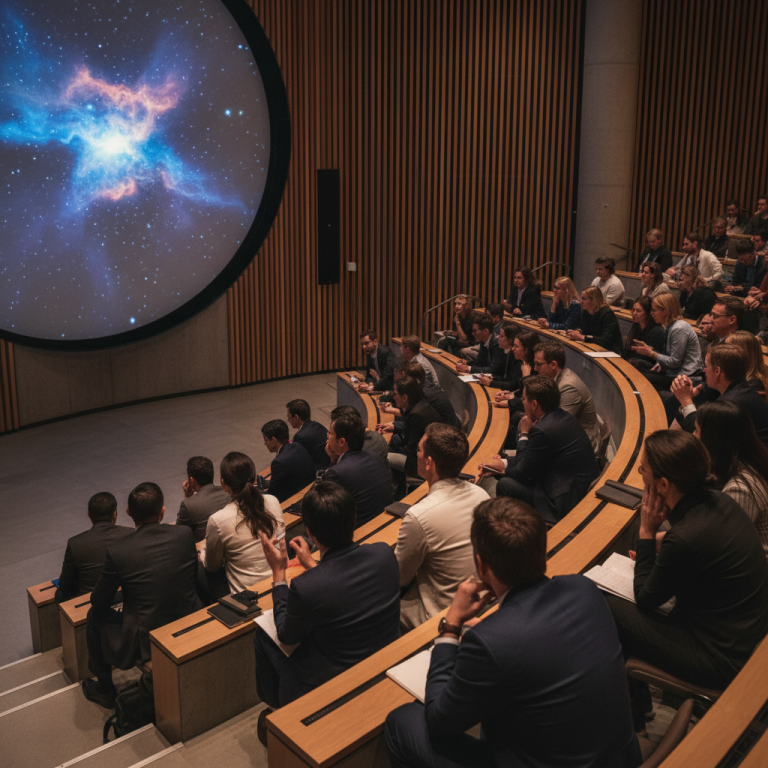

In an era increasingly dominated by algorithmic certainty and instant factual retrieval, a growing counter-movement in public discourse is advocating for the deliberate embrace of ambiguity. A recent presentation from the educational platform Portal to Ascension examines a central philosophical inquiry: what occurs socially, intellectually, and personally when communities intentionally build space to address phenomena for which society lacks definitive answers? The video frames this practice not merely as an intellectual exercise, but as an essential cultural mechanism for expanding the boundaries of human inquiry.
The issue resonates at a time when institutional trust remains volatile and mainstream scientific, academic, and media frameworks often struggle to accommodate anomalous experiences or unconventional viewpoints. By interrogating the friction between dogmatic certainty and open-ended exploration, the discussion highlights how dialogue surrounding unresolved questions can foster innovation, psychological resilience, and collective understanding.
The Urge to Question Beyond Established Boundaries
Human history is punctuated by shifts that began not with consensus, but with individuals and small groups gathering to interrogate what was previously considered settled or unknowable. The video posits that modern culture frequently prioritizes definitive conclusions over rigorous questioning, leading to environments where unanswered anomalies are marginalized rather than investigated.
When individuals encounter experiences or theoretical concepts that fall outside orthodox scientific models—ranging from profound alterations in consciousness to unexplained physical phenomena—the absence of structured conversational venues often creates social alienation. As noted in the presentation, creating room for unresolved topics legitimizes the instinct of curiosity itself, treating the unknown not as an intellectual defect, but as the natural horizon of knowledge.
By prioritizing dialogue over debate, exploratory platforms attempt to shift the objective of communication from winning an argument to collectively mapping the contours of human ignorance. This transition allows participants to examine anomalous data without the immediate burden of defending an all-encompassing ideological framework.
The Epistemological Challenge of the Unknown
At the core of the video’s thesis is an epistemological paradox: established paradigms often determine what questions are permissible to ask. When academic or cultural institutions dictate that only topics with pre-existing evidentiary pathways are worth exploring, novel phenomena risk systemic neglect.
The video observes that when communities convene specifically around open questions, they challenge the default assumption that every mystery must immediately be solved or dismissed. A willingness to sit with unsettled questions mirrors historical shifts in philosophy and the sciences, wherein foundational discoveries often emerged after long periods of observational bewilderment.
“What happens when we make space for conversations about the things we don’t always have answers for is that we give ourselves permission to grow beyond the limits of current certainty.”
This perspective demands a degree of intellectual humility that is increasingly rare in public life. Rather than demanding binary solutions—accepting or debunking a premise on immediate contact—the conversational approach encourages iterative investigation, where multiple hypotheses can be entertained without immediate commitment to dogma.
Digital Spaces as Modern Salons for Fringe Dialogue
Over the past two decades, independent media channels, grassroots conferences, and digital platforms like Portal to Ascension have emerged as alternative gathering grounds, functionally serving as modern digital salons. These forums frequently address subjects historically relegated to the fringes of academia, including transpersonal psychology, ancient civilizations, and anomalous aerial events.
The presentation emphasizes that the structural format of these discussions dictates their outcome. When platforms are designed around collaborative inquiry rather than adversarial click-driven conflict, participants are significantly more likely to share anomalous observations, subjective experiences, and theoretical models without fear of reputational penalty.
This democratization of discussion is not without complexity. As unconventional topics enter broader circulation, the lines between speculative curiosity, empirical inquiry, and unsupported assertion often blur. However, the video argues that suppressive consensus does not eliminate confusion; instead, open, transparent forums provide a healthier environment for processing unresolved phenomena than fractured, isolated echo chambers.
Navigating Uncertainty: Intellectual Humility Versus Dogmatism
A critical theme examined in the discourse is the psychological toll of enforced certainty. Modern social media architectures reward decisive, polarization-friendly assertions, penalizing nuanced admissions of doubt. The video highlights how this dynamic truncates intellectual maturation, conditioning audiences to reject anything that does not immediately fit an existing mental taxonomy.
Conversely, normalizing unresolved inquiries encourages emotional and intellectual resilience. When individuals accept that some inquiries—such as the fundamental nature of consciousness, the origins of life, or the boundaries of space and time—may remain incomplete across generations, they cultivate a tolerance for ambiguity that tempers both dogmatism and cynicism.
The presentation suggests that true critical thinking does not solely consist of applying established rules to incoming data; it requires recognizing when incoming data suggests the rules themselves may be incomplete. Encouraging dialogue on these frontiers allows participants to distinguish between genuine skepticism and defensive cynicism.
Key Takeaways from Exploratory Discourse
The philosophical framework advanced by Portal to Ascension underscores several structural shifts that occur when exploratory dialogues are prioritized:
- De-escalation of Conflict: Moving away from debate structures toward open inquiry reduces defensiveness, permitting diverse perspectives to coexist without an immediate struggle for dominance.
- Legitimization of Personal Experience: Providing a venue for unexplained or anomalous observations reduces the isolation experienced by individuals whose encounters defy standard categories.
- Expansion of Scientific Horizons: Acknowledging gaps in current understanding historical precedents demonstrates that anomalies often drive the next paradigm shift in systematic research.
- Cultivation of Community: Shared exploration of existential and philosophical questions establishes deep communal bonds rooted in mutual curiosity rather than shared dogma.
- Protection Against Polarized Thinking: Embracing uncertainty trains thinkers to resist simplistic, binary answers to complex existential dilemmas.
The Cultural Shift Toward De-Stigmatizing Anomalous Studies
The arguments presented in the video arrive amid a wider cultural recalibration regarding previously marginalized subjects. Over the past several years, topics such as unidentified anomalous phenomena (UAP), non-ordinary states of consciousness, and unconventional archaeological theories have received increased scrutiny from mainstream institutions, legislative bodies, and academic departments.
This broader trend validates the central contention of exploratory platforms: topics once dismissed as inherently unanswerable or unscientific often reflect limitations in methodology rather than intrinsic invalidity. By facilitating these discussions before mainstream institutions catch up, grassroots platforms often serve as preliminary testing grounds for ideas that eventually migrate toward conventional consideration.
The video points out that public willingness to engage with these themes often outpaces academic bureaucracy. When public curiosity outstrips institutional frameworks, independent dialogues become critical cultural valves, enabling thoughtful citizens to parse emerging ideas collaboratively rather than in isolation.
Balancing Openness with Rigorous Discernment
While championing open discourse, the presentation also touches upon the ongoing challenge of maintaining discernment within exploratory spaces. Openness to the unexplainable does not require the suspension of reason; rather, it demands an even more refined analytical framework capable of holding multiple possibilities without uncritically adopting any single claim.
The video implies that the most effective forums for open-ended conversation are those that explicitly discourage premature conclusions from all directions. Treating an unanswered question as solved—whether through premature dismissal or uncritical embrace—ultimately terminates the conversation and closes the exploratory space.
To sustain these dialogues over the long term, participants are encouraged to develop a disciplined neutrality, evaluating observations and hypotheses on their merits while remaining fundamentally comfortable leaving the file open. It is precisely this ongoing state of open inquiry that preserves the vitality of community-driven philosophical forums.
What to Watch Next
As conversations surrounding unresolved mysteries, non-traditional sciences, and existential philosophy continue to expand across independent channels, observers are closely tracking how these grassroots efforts interface with established academic fields. The ongoing trajectory of platforms like Portal to Ascension suggests that demand for non-dogmatic, curiosity-centered spaces will remain strong, particularly as institutional paradigms encounter anomalies they can no longer easily dismiss.
Future discussions on these channels are expected to delve deeper into the intersection of personal consciousness, collaborative investigation methodologies, and the societal implications of living comfortably alongside the unknown.