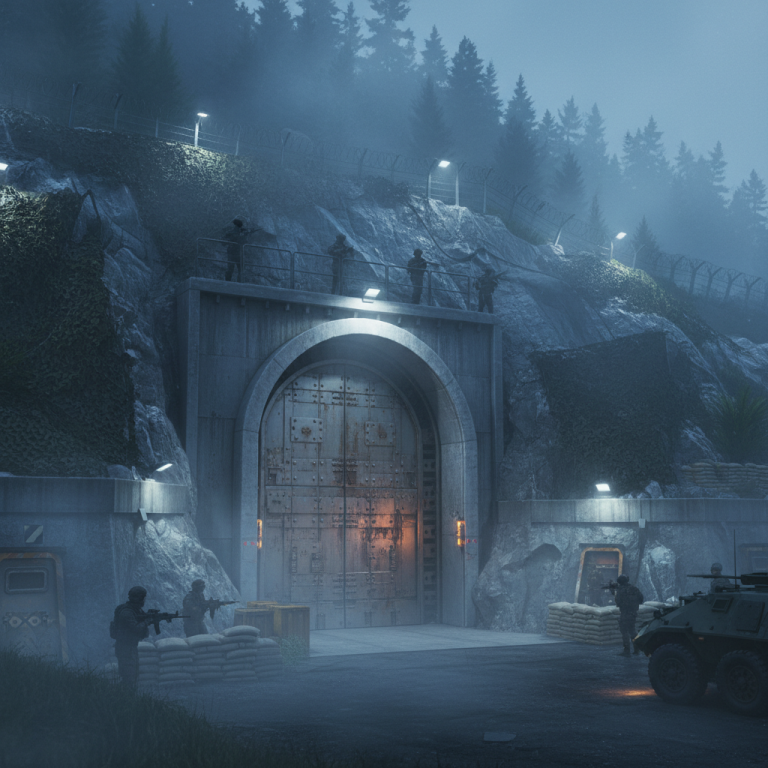

In the fourth installment of his serialized investigative video series exploring the enigmatic “Green Mountain” complex, exopolitics researcher Dr. Michael Salla examines the structural authority and command networks alleged to oversee covert subterranean infrastructure. The presentation centers on long-standing claims within alternative national security circles that vast, deeply buried installations operate largely outside conventional congressional and civilian oversight, governed instead by an opaque consortium of intelligence directorates, aerospace contractors, and military elements.
The persistent discourse surrounding deep underground installations touches on broader public concerns regarding transparency, military spending accountability, and the boundaries of executive authority. As public interest in anomalous aerospace phenomena and special access programs continues to mount within Washington, analyses that probe who exercises ultimate command over compartmentalized operations highlight an enduring skepticism toward official institutional narratives.
The Architecture of the Green Mountain Investigation
Throughout the multi-part investigation, Salla traces the geographical and historical contours of what researchers term the Green Mountain puzzle. While subterranean defense infrastructure has been a recognized component of Cold War continuity-of-government planning since the mid-20th century, the Green Mountain series seeks to distinguish between verified civil defense shelters and what proponents claim are far more expansive, highly classified networks designed for advanced aerospace research and operational secrecy.
In this fourth chapter, the narrative pivots from physical geography to systemic governance. Rather than merely asking what exists beneath mountain strata, the inquiry interrogates the institutional mechanisms that finance, staff, and direct these spaces. Salla argues that understanding the hierarchy behind classified subterranean installations is essential to deciphering modern geopolitical power dynamics, particularly where national defense merges with high-level aerospace contracting.
Decoupling Subterranean Reality from Cold War Precedent
To contextualize claims regarding covert mountain facilities, observers often reference acknowledged historical installations such as the Cheyenne Mountain Complex in Colorado or the Raven Rock Mountain Complex in Pennsylvania. Built to withstand nuclear strikes and ensure the survivability of strategic command, these verified bastions demonstrate that the United States military invested heavily in subterranean engineering during the latter half of the twentieth century.
However, as the video underscores, alternative defense analysts argue that public-facing bunkers represent only the visible perimeter of a much broader initiative. The presentation contends that parallel, black-budget programs expanded far beyond standard contingency planning, creating subterranean enclaves insulated from standard legislative checks and balances. The transition from legitimate continuity-of-government protocols to alleged autonomous command hubs forms the core tension explored in the presentation.
The Mechanics of Unacknowledged Special Access Programs
Central to Salla’s thesis is the operational framework of Unacknowledged Special Access Programs, commonly referred to as USAPs. Within United States security classification law, such programs possess security measures so stringent that their very existence is denied to all but authorized personnel with specific operational need-to-know access.
According to the commentary presented in the video, this extreme compartmentalization allows specific elements within defense intelligence to construct parallel chains of command. By fragmenting technical projects and operational directives across multiple private contractors and covert military commands, project architects prevent even high-ranking military officers and elected lawmakers from assembling an integrated picture of program goals. Salla frames the control of the “hidden world” not as a single monolithic dictatorship, but as a hyper-compartmentalized network maintained through bureaucratic gatekeeping and non-disclosure enforcement.
The Pivotal Role of Aerospace Contractors
A primary focus of part four is the transfer of sensitive technical assets and logistical management from military branches into private corporate care. The video suggests that leading aerospace defense conglomerates serve as more than mere equipment vendors; they function as protective custodians of the most deeply guarded state secrets.
The strategic advantage of routing classified operational stewardship through private corporations lies in legal insulation. Because private entities are generally exempt from standard Freedom of Information Act disclosures and direct congressional committee audits, highly sensitive aerospace prototypes and subterranean research initiatives can theoretically remain hidden indefinitely. Salla suggests that corporate boardrooms and specialized proprietary security units wield a degree of influence over these hidden assets that often rivals or exceeds that of public administrative officials.
“The question of who ultimately commands these deeply buried installations challenges the traditional constitutional framework, revealing a systemic bifurcation between public governance and compartmentalized national security operations.”
Exopolitical Paradigms and Non-Human Technology Claims
Operating from Salla’s established exopolitical background, the episode delves into the controversial proposition that subterranean facilities house reverse-engineered advanced propulsion technologies and non-human biological evidence. While traditional investigative journalists treat these accounts with deep skepticism due to a lack of publicly verifiable documentation, they form a cornerstone of the community Salla addresses.
The video links the governance of the underground realm directly to international agreements allegedly negotiated during the mid-20th century regarding anomalous technological retrieval. Within this speculative framework, the entities that control the hidden complexes act as gatekeepers for disruptive energy systems, propulsion physics, and contact management. Salla argues that secrecy is preserved not merely to maintain military tactical superiority, but to prevent the collapse of existing economic and institutional paradigms reliant on conventional energy and geopolitical hegemony.
Whistleblower Testimony and the Problem of Verification
A significant portion of the evidentiary framework cited in the video rests on testimony from individuals claiming prior involvement with classified military commands, intelligence agencies, or defense contract engineering. Salla synthesizes various historical accounts, drawing parallels between accounts given by military whistleblowers across several decades.
Nevertheless, independent verification of these claims remains notoriously complex. Institutional critics and academic researchers routinely note that classified environments deliberately obscure documentation, creating an environment where authentic disclosures, psychological operations, and unfettered mythology easily intermingle. The presentation acknowledges these verification challenges while maintaining that recurring consistencies across disparate testimonies suggest an underlying operational reality that standard investigative paradigms have failed to adequately penetrate.
Key Takeaways from the Presentation
- Compartmentalized Governance: Control over subterranean installations is structured around tightly restricted Special Access Programs that bypass conventional executive and legislative scrutiny.
- Corporate Custodianship: Private aerospace contractors allegedly manage and safeguard the technological assets located within deep mountain complexes, insulating them from public auditing laws.
- Continuity of Government Evolution: Cold War survival facilities are cited as the logistical foundation from which an autonomous black-budget subterranean infrastructure expanded.
- Information Gatekeeping: Strict legal, financial, and operational silos are maintained to protect classified research involving advanced propulsion and non-conventional physics.
- Sovereign Oversight Deficits: The video emphasizes that elected civilian leaders possess limited visibility into, and control over, the deepest layers of classified subterranean infrastructure.
Analyzing the Constitutional and Oversight Implications
Beyond the speculative dimensions of alternative technology, the issues raised by the Green Mountain series highlight legitimate ongoing debates concerning military transparency. Over the past several years, the United States Congress has enacted bipartisan legislation through the National Defense Authorization Act directing the Department of Defense to locate, review, and declassify records concerning anomalous aerospace programs and related legacy operations.
Testimonies delivered before congressional subcommittees by former intelligence officials have renewed public discussion regarding whether legacy special access programs evade proper Title 10 and Title 50 statutory reporting. When figures like Salla examine who commands subterranean facilities, their arguments resonate with an audience increasingly primed by mainstream hearings to believe that critical defense secrets remain sequestered outside the boundaries of conventional democratic oversight.
What to Watch Next
As the Green Mountain mystery series develops, future installments are expected to focus on the operational interaction between alleged subterranean facilities and surface-level defense deployments. Observers and community followers will be watching to see whether Salla introduces newly surfaced documentation, further insider testimonies, or geospatial analyses to substantiate the theoretical command structures outlined in part four. Meanwhile, ongoing legislative pushes for greater transparency around military special access programs will continue to provide a high-profile real-world backdrop against which these alternative investigations are evaluated.